
Introduction
Getting a manuscript into readers’ hands in 2026 is not the hassle it once was, yet the process still overwhelms so many authors that a good number give up halfway through. We get excited about the idea of releasing our work, we tell our friends and family, and years later the manuscript is still sitting unfinished. Even authors who have already released one title often have several more waiting for attention.
Why does this keep happening? Usually it comes down to ignoring the real cost of the project. A quick search online tends to produce answers that are either too vague to trust or so high they make the idea of working with a book publisher feel out of reach.
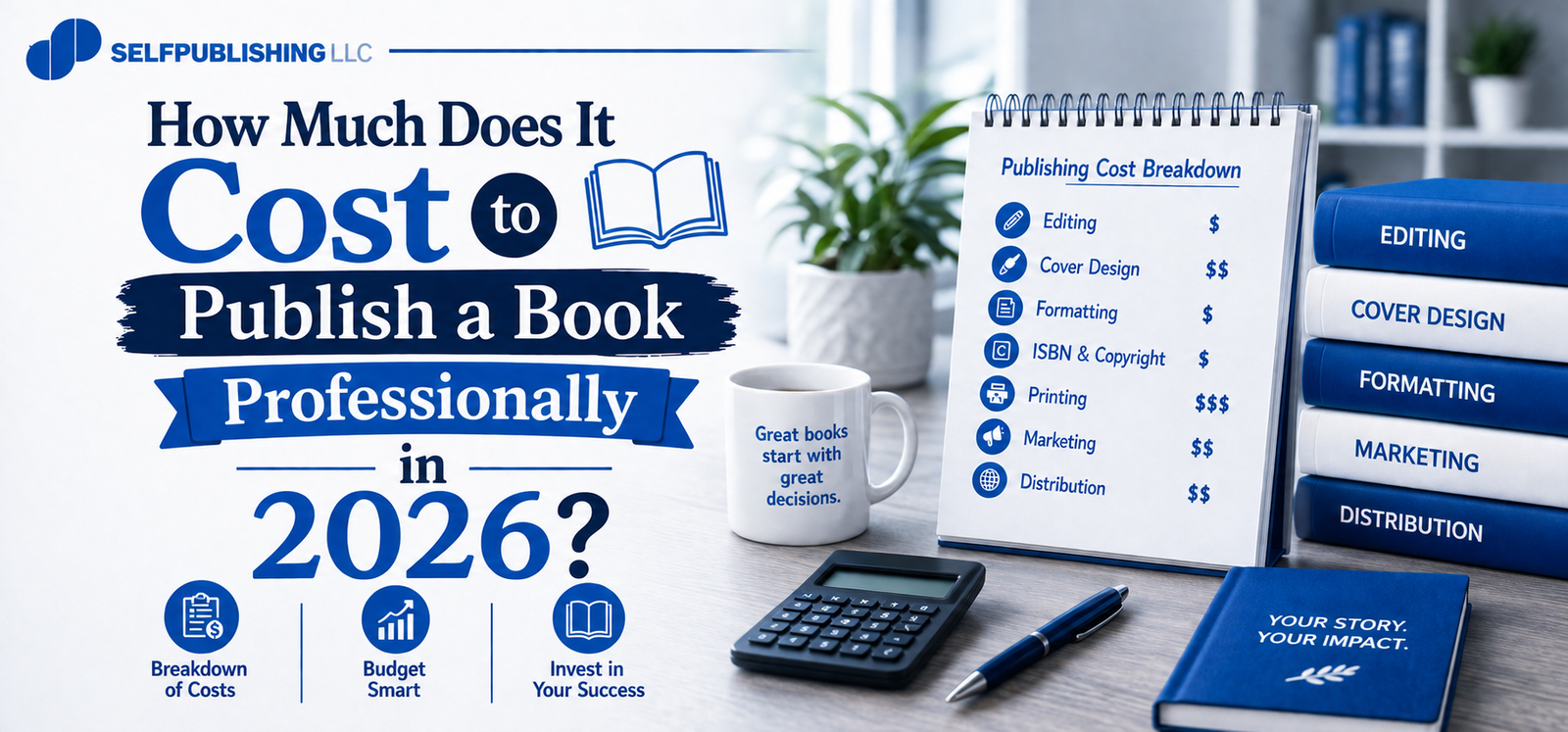
The truth is that cost depends entirely on the choices you make. What your manuscript needs, how polished you want the final product to look, and which route you choose all shape the final number. This guide breaks down the real costs behind publishing a book: editing, cover design, formatting, printing, distribution, and marketing, and shows where you can save without hurting quality.
In this guide, you can expect to learn:
- Why the cost of publishing varies so much from author to author
- Whether publishing actually requires spending any money at all
- The main factors that drive cost up or down, including length, genre, and editing depth
- What happens (and what you pay for) at each stage, from manuscript evaluation to launch
- What it really costs to self-publish a book, broken into low-cost, mid-level, and professional tiers
- What’s different about self-publishing a novel compared to other genres
- What publishing on Amazon does and doesn’t cover
- Where you should never cut corners, and where you safely can
- How to build a realistic publishing budget in five simple steps
Why Publishing Costs Feel So Confusing
There is no single answer to how much to publish a book, because it depends on the level of service and expertise involved. A short children’s ebook with light proofreading costs far less than a 300 page novel needing developmental editing, professional formatting, and custom illustrations. A memoir written for family will not need the same budget as a business book meant to build authority.
Many first time authors get stuck here because they assume publishing is one single service rather than a collection of different skills. Before asking about price, it helps to ask what kind of experience you want your readers to have. That question changes everything that follows.
Does It Cost Money to Publish a Book?
It can cost nothing, or it can cost thousands, depending on the path. A do it yourself approach through a self-publishing platform can be free. Professional publishing, on the other hand, means paying for editing, design, and formatting, whether you hire a team or work with individual freelancers. Neither route is better by default, it simply depends on your goals.
Main Factors That Affect Cost
Word Count. Longer manuscripts take editors, proofreaders, and formatters more time, and require more paper to print, so cost rises with length.
Genre. A novel needs attention to pacing and character arcs. A memoir needs careful handling of sensitive material. A business book needs clarity and authority. Each genre carries its own production needs.
Editing Needs. There are several editing types, developmental, line, copyediting, and proofreading, and the more stages a manuscript requires, the higher the cost.
Cover Design Quality. A cover is a sales tool, not decoration. Book cover designing that matches genre expectations increases trust and likeability, while a simple cover may be enough for a small scale project.
Interior Formatting. Clean margins, page numbers, a clickable table of contents, and consistent layout affect the reading experience as much as the writing itself.
Publishing Route. Traditional publishing removes production costs from the author but takes longer and requires agent submissions. Self-publishing gives full control but shifts every cost to the author. Hybrid publishing sits in between, with pricing that varies by what is included.
Marketing Goals. A book without a marketing plan can be published but never discovered. This includes author website content, social posts, press releases, and launch strategy.
Where the Money Goes
A manuscript evaluation gives a professional opinion on structure, pacing, and reader engagement, helping you avoid paying for the wrong service. Developmental editing then addresses the big picture, plot, character arcs, and structure for fiction, or argument and flow for nonfiction. Line editing and copyediting sharpen language, grammar, and consistency without losing the author’s voice. Proofreading is the final check that catches typos and small errors before release, and skipping it is risky even after a strong edit.
Cover design must work at thumbnail size since most readers see books online first, and print editions also need a spine and back cover built to printer specifications. Interior formatting must work across devices for ebooks and look clean on the page for print, especially with images, tables, or footnotes.
Administrative setup includes ISBNs, which may need to be separate for print, ebook, and audiobook formats, along with copyright registration and metadata such as categories, keywords, and author bio. Printing costs shift with trim size, paper, binding, and whether you choose print on demand or bulk printing. Distribution then depends on strong metadata and accurate pricing so the book appears in the right categories and reaches the right readers. Finally, marketing and launch support, from press releases to email campaigns, determines whether a well written book actually finds an audience.
Cost To Self Publish A Book: What Authors Should Expect
The cost to self publish a book depends on how much you do yourself versus how much help you hire. A company like Self Publishing LLC gives authors control over editor, designer, formatter, platform, and pricing, but that control also brings responsibility for quality. Self publishing a book is not automatically cheap. Main expenses usually include editing, book cover designing, formatting, ISBNs, proof copies, and marketing, with illustrations, indexing, or audiobook production as optional add ons.
Readers rarely care whether a book is traditionally or self published, they care whether it feels worth their time. At Self Publishing LLC, professional self publishing means using the freedom of the self-publishing model while still meeting professional standards.
Three Levels of Self-Publishing
Low cost self publishing means the author does nearly everything alone, editing, design, and formatting included. This can work for a simple project or small audience, but self editing is difficult and a homemade cover may not match genre expectations.
Mid level self publishing means hiring help for the most important parts, usually editing, cover design, and formatting, while the author manages the upload and publishing account. This suits organized authors who want quality without a full service package.
Professional book publishing means building a complete process around the book, evaluation, editing, proofreading, cover design, formatting, ISBN guidance, distribution, and launch planning. Some authors hire individual freelancers while others work with book publishing companies that manage everything under one roof, often bundling book editing services with design and distribution support. This route costs more but reduces mistakes and saves time.
Why the Cheapest Route Is Not Always Best
Cutting corners early can become expensive later. A poor cover may need a redo, a weak edit can lead to bad reviews, and a rushed launch may fail to gain traction. The goal is not the cheapest option but the right services for the specific book.
How Much Does Novel Publishing Cost?
Novel publishing carries its own demands because a novel is a full reading experience built on flow, tension, and character growth. It may need developmental editing for plot and pacing, line editing for voice and rhythm, copyediting for grammar and consistency, and proofreading before release. A rushed manuscript reads like a draft, while a professionally prepared one feels like a finished book, and that difference is what readers notice.
Amazon Publishing Cost
Amazon has made publishing more accessible, which is why so many authors search for amazon publishing cost before exploring any other route. In many cases you can upload to Amazon KDP without an upfront platform fee, but the upload itself is not the whole picture.
The real amazon self publishing cost comes from preparing the book beforehand: editing, proofreading, cover design, ebook and paperback formatting, description writing, categories, keywords, and marketing. For print, production cost affects royalties, and for ebooks, pricing and file size play a role. Amazon provides access, not automatic quality or visibility, and a crowded marketplace still requires a strong cover, clear title, and enough marketing momentum to stand out. Authors who search for amazon self publishing cost figures are usually trying to budget for this preparation stage, not just the free upload itself.
Traditional vs. Self-Publishing: Which Costs More
Traditional publishing usually covers editing, design, printing, and distribution if a publisher accepts the manuscript, but acceptance can take a long time and the author gives up creative control. Self publishing a book usually costs more upfront since the author pays for professional services, but it keeps timeline, creative direction, and final decisions in the author’s hands. Hybrid or assisted publishing sits between the two. At Self Publishing LLC, authors typically pay for services while receiving professional support across editing, design, formatting, and distribution, though pricing varies by what is included, and some packages fold in book editing services alongside cover work and formatting.
Where You Can Save Without Hurting Quality
Prepare your manuscript before sending it to an editor by removing repetition and fixing obvious mistakes. Beta reader feedback before professional editing can catch confusing sections early. Print on demand avoids large inventory costs, and marketing can stay focused on the channels that actually match your readers rather than trying to do everything at once.
Timing also matters. Authors who rush every step in the book publishing process at once often end up paying twice, once for the original work and again for corrections after the fact. Spacing out the process, evaluation first, then editing, then design, then formatting, then distribution, tends to protect both the budget and the final quality. A clear checklist before hiring anyone also helps, since it prevents paying for overlapping services from two different freelancers who assume the other has already covered a step.
Planning a Realistic Publishing Budget
Start with your goal, since a book for family does not need the same budget as one aimed at national visibility. Choose your publishing route, whether traditional, self-publishing, hybrid, or a full-service option through a dedicated author services team. List the must-have services, usually editing, proofreading, cover design, formatting, and distribution prep. Understand the natural order of the work, since following it reduces costly rework. Finally, leave room for revisions and even a modest marketing plan.
So, How Much To Publish A Book Professionally?
The honest answer is that it depends on the manuscript, the author’s goals, the route chosen, and the marketing plan behind it. A free upload is possible, but a polished professional book usually requires investment, and understanding where that investment goes is what makes the decision feel less overwhelming.
Some authors will spend modestly and still produce something readers enjoy, simply because they planned with care. Others will spend far more and still end up disappointed, because they rushed decisions or skipped a step that mattered. The smartest budget is rarely the biggest one. It is the one that matches what the book is actually meant to do, and it is built with clear eyes rather than guesswork.
FAQs
Can I self-publish a book for free?
Yes, through platforms like Amazon KDP if you handle every step yourself, though a polished result usually still needs professional editing services, design, and formatting help.
What is the biggest self-publishing expense?
Editing is usually the largest expense since it demands time and close attention, though cover design, formatting, and marketing also add to the total.
What is the cheapest way to publish professionally?
Focus on essentials first: a clean manuscript, the right level of professional editing services, a solid cover, and proper formatting, while avoiding unnecessary extras early on.
Do I need an ISBN?
It depends on your goals. Some platforms offer a free ISBN, but buying your own gives more control if you want a distinct publishing imprint and wider distribution.
Why do book publishing companies charge different prices?
Because service levels differ. Some only handle formatting and upload, while others, including a full a book publisher package, cover editing, design, distribution, marketing, and ongoing support.
Is self-publishing cheaper than traditional publishing?
It depends on how you measure cost. Traditional publishing may cost less upfront but more in time and control, while going the self-publishing route usually costs more upfront but keeps decisions in the author’s hands.