
Introduction
Self publishing a book is no longer a side road for authors who “couldn’t” get picked up elsewhere. It is a serious path, but one that puts more responsibility on the writer. The author becomes the decision-maker, and that can be powerful when the right support is in place.
This guide breaks down what self-publishing packages actually include, what to check before buying one, the real costs involved, the red flags to avoid, and how to match a package to what your manuscript actually needs, whether you’re writing fiction or nonfiction.
A few things to expect in this guide:
- A clear breakdown of what a self-publishing package actually is, and how it compares to going the DIY route
- A checklist of core services to look for, from editing to cover design to distribution
- A realistic look at pricing tiers, hidden costs, and how royalties work
- A list of red flags that signal a predatory or overpromising company
- Guidance on matching the right tier of support to your specific manuscript
What Is a Self Publishing Package?
Self publishing a book means taking on the role of publisher yourself, and a self-publishing package is simply a bundle of services that helps authors reach that goal without hiring each service separately. It may cover only editing, or it may span the full process: editing, proofreading, design, ebook conversion, ISBN, distribution, and marketing.
At their best, these packages bring structure to a process that can feel scattered. At their worst, they blur details and bundle weak services under impressive names. The better question isn’t “what’s included,” it’s “does what’s included actually serve this book?”
Why New Authors Use Packages
A publishing package should include the services required to prepare the book for readers. For example, at Self Publishing LLC, the packages are clear about what the authors would find in the services, what to expect, and the overall publishing path. This plan helps authors know how the books will be distributed in the market and what will happen after their book publication.
A writer may understand story and voice but not trim size, metadata, or ISBN ownership. A package gives one guided path instead of many scattered tasks, along with access to professionals who know what makes a finished book look finished.
Authors typically want a cleaner process, real editorial support, a strong cover, proper formatting, ISBN and distribution help, and someone to answer questions along the way. Most first-time authors aren’t trying to skip the work. They’re trying not to lose months learning it the hard way.
Package vs. DIY
DIY self-publishing puts the author in charge of every step, whether done alone or through separate freelancers. A package puts everything under one roof, usually at a higher price but with less time and technical risk.
DIY may suit authors with publishing experience, freelancer-management skills, and a strong desire for full control on a tight budget. A package tends to suit authors who are new to the process, unfamiliar with file prep, and looking for one coordinated team to carry editing, design, formatting, and distribution.
There’s no universal right answer here. Some authors thrive juggling separate freelancers for each stage; others find that publishing a book this way stretches out for months longer than expected, simply because coordinating multiple vendors takes real project-management skill on top of the writing itself. If you’d rather spend that time writing your next book, a package usually saves more than it costs.
What Should Be Included
Editing and Proofreading
Editing a book well is one of the most important parts of any package, since even a great story loses readers if the prose is weak. Getting this stage right early saves money later, since a poorly edited manuscript often needs a second, more expensive pass once formatting has already begun. There are four layers: developmental editing (structure and pacing), line editing (style and flow), copyediting (grammar and consistency), and proofreading (final catch after formatting).
“Editing included” can mean very different things. Before buying, ask what type of editing is covered, how many words it applies to, who performs it, whether tracked changes are provided, and whether proofreading happens after formatting.
Cover Design
The cover carries the book’s first impression. Confirm whether the package covers front cover design, a full paperback wrap with spine and back cover, hardcover design if needed, ebook and print-ready files, and a set number of revisions.
Interior Formatting
Formatting keeps font, spacing, and layout consistent for both print and ebook. Ask whether both formats are included, which file types you’ll receive (print-ready PDF, EPUB), and whether corrections are covered after a proof review.
ISBN and Copyright
Every format, paperback, hardcover, and ebook, needs its own ISBN. Whoever provides the ISBN may be listed as publisher of record, so ask who owns it, who is listed as publisher, and whether copyright registration is included or just explained.
Ebook Conversion
Poor conversion creates broken links, odd spacing, and missing images. Ask whether the file will be tested, whether the table of contents is clickable, and whether images are optimized before upload.
Print Setup and Distribution
This covers trim size, bleed, spine width, and getting the book ready to print a book on demand through platforms like Amazon KDP or IngramSpark. That print-on-demand model is part of what makes publishing a book independently financially realistic today, since there’s no large upfront print run to fund before a single copy sells.
Distribution makes the book available for sale, but it doesn’t guarantee sales, and “global distribution” rarely means bookstores will stock it automatically. Ask where the book will be listed, whether bookstores can order it, and who controls pricing and royalty reporting.
Author Copies and Marketing
Check how many author copies are included, whether shipping is covered, and what extra copies cost. On marketing, ask for specific deliverables, book description writing, keyword research, a press release, launch checklist, rather than a vague promise of “promotion.”
Types of Packages
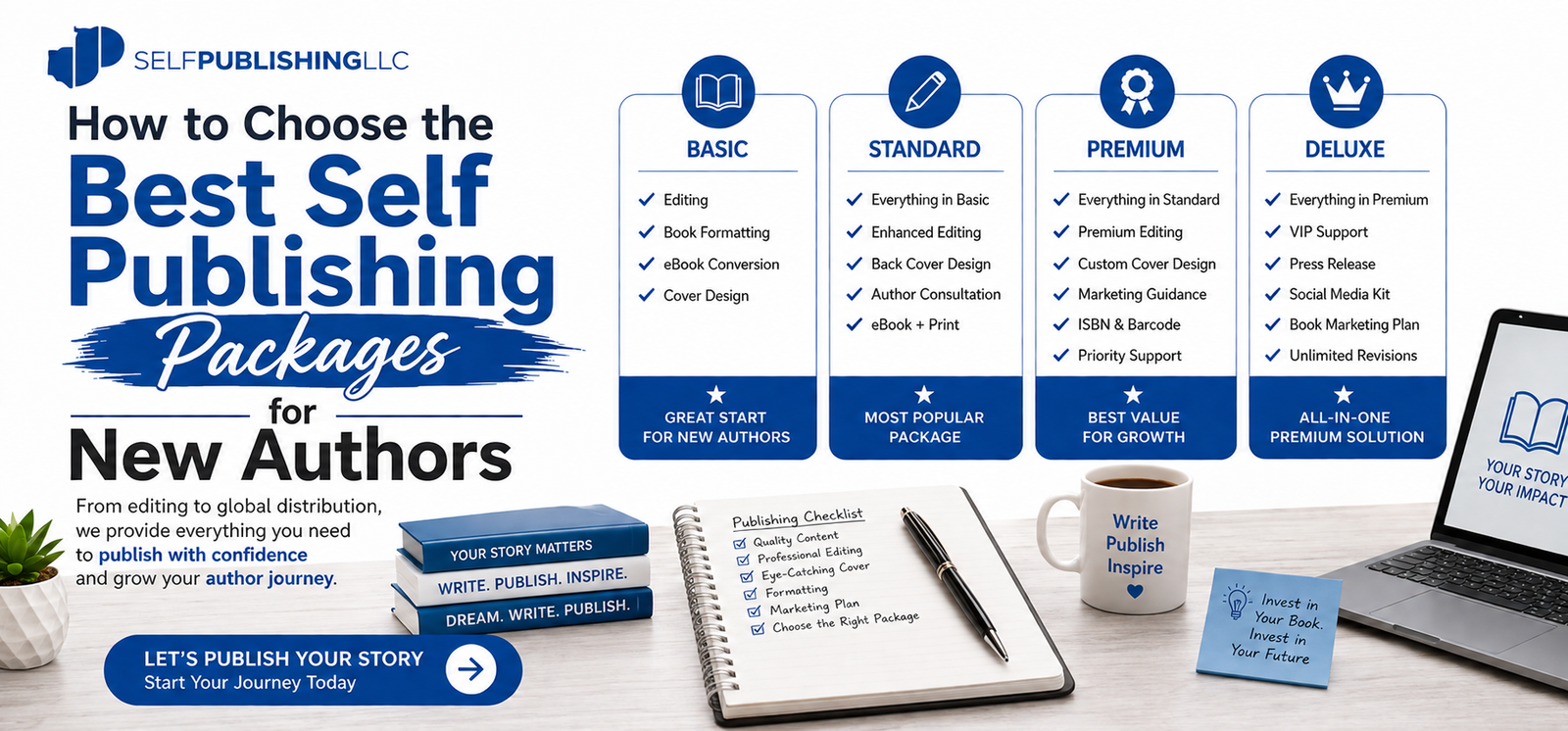
Basic packages cover the minimum: light formatting, ebook conversion, a simple cover, and platform setup. Good for short books or authors who’ve already hired an editor, risky for manuscripts that need real editing.
Standard packages add editing, custom cover design, formatting, and distribution assistance, often the most balanced choice for first-time authors.
Full-service packages add proofreading, copyright guidance, marketing support, an author website, and project management. Valuable for hands-on guidance, but ask whether it’s genuinely full-service or just full of add-ons.
Genre-specific packages exist for children’s books, memoirs, and faith-based titles, among others. A children’s book may need illustration support and fixed-layout formatting; a memoir may need editing focused on structure and sensitivity. Ask for portfolio samples in your specific genre, including examples relevant to self publishing a novel if that’s your project. Fiction and nonfiction covers read very differently to readers, so a design team that’s only worked in one genre may not serve the other well.
How to Choose the Right Package
Define your goal first. Is the book for friends and family, for online sale, for bookstores, or the start of a long-term author career? Write one clear sentence describing what you want, and use it to filter every package you consider.
Get a written list of deliverables. Editing type, word count limits, revision rounds, file formats, distribution platforms, and post-publication support should all be spelled out before you pay.
Compare pricing and hidden costs. Ask about extra fees for longer manuscripts, additional ISBNs, author copies, shipping, and file changes after publication.
Review sample work. Ask to see edited manuscripts and finished covers. If editing a book is your main concern, this step matters more than any other; a company can have a polished sales page and weak production work, and the portfolio tells the truer story.
Understand rights and royalties. You should retain the rights to your book. Ask who owns the copyright, the cover design, and the final files, and how royalties are calculated and reported.
Check distribution fit. If you want bookstore or library access, ask specifically about IngramSpark. If Amazon sales are the priority, confirm KDP setup and account access.
Notice communication before you pay. A company that’s hard to reach beforehand is usually harder to reach afterward.
What Packages Typically Cost
Pricing depends on editing depth, book length, design complexity, and distribution support.
Basic packages are the cheapest but usually skip deep editing and real marketing, useful mainly for authors with an already-polished manuscript.
Mid-level packages typically include editing, custom design, formatting, ISBN support, and basic marketing assets, often the most practical range for a first book.
Premium packages add deeper editing, hardcover setup, marketing strategy, and project management. It should mean better quality, not just more line items, so ask for samples before committing.
The cheapest option only makes sense if you know exactly what’s missing and can cover it elsewhere. Skipping editing or design to save money often leaves the finished book looking unfinished, and readers notice that faster than any marketing plan can fix.
It also helps to think about cost per stage rather than one lump sum. A manuscript that already has a strong developmental edit behind it may need very little from a package beyond design and setup, while a first draft may need the entire pipeline. Ask for a breakdown by service so you can see exactly where your money is going, rather than one flat number that hides the balance between editing, design, and distribution work.
Red Flags to Watch For
- Unrealistic promises: no company can guarantee bestseller status, bookstore placement, or a specific sales number.
- Unclear pricing: vague package names, missing details, and surprise fees are warning signs.
- Poor contract terms: watch for broad rights claims, unclear royalties, harsh cancellation rules, or no control over your own publishing accounts.
- Pressure tactics: urgency language like “this offer disappears today” should raise concern.
- Vague royalty explanations: you should be able to get a straight answer on retail price, print cost, retailer discount, and payment frequency.
- No samples: a company that can’t show finished work shouldn’t be trusted with yours.
None of these signals alone proves a company is dishonest. Some pricing genuinely varies by manuscript length, and some upgrades really do add value. What matters is whether the company explains itself clearly when asked. A serious provider welcomes hard questions about rights, royalties, and cost. One that deflects, rushes you toward a decision, or answers in generalities is telling you something important about how the rest of the relationship will go.
A good company like Self Publishing LLC helps the author understand choices, not just push services. It speaks clearly about rights, distribution, editing, design, timelines, and expectations. In the end, the “best” company is not always the largest company. It is the one that fits the author’s book, budget, genre, and communication style.
Checklist Before You Buy
Confirm the package addresses: manuscript evaluation, a clearly defined editing level, proofreading after formatting, custom cover design, interior formatting for both formats, ISBN and copyright guidance, the setup needed to print a book on demand, distribution, author copies, revision rounds, a timeline, final file access, and a clear royalty explanation.
Ask directly: What’s included and what isn’t? Who owns the ISBN and the final files? Where will the book be distributed? How and how often are royalties paid? What happens if I’m unhappy with a service?
Matching a Package to Your Needs
Authors on a tight budget should avoid the very cheapest option if the manuscript still needs real editing; a lighter package paired with separate editing support is often the smarter route. Authors who already have a strong manuscript, including many self publishing a novel with a polished draft in hand, may only need cover design, formatting, and distribution help. Authors who want visibility after launch should look for specific marketing deliverables rather than vague promises. Authors who want one team managing everything, from editing through distribution, may be best served by a full-service package with strong communication built in.
Are Self Publishing Packages Worth It?
It depends on the package, the author, and the book. A package is worth it when it solves real problems, includes professional-quality work, protects your rights, and matches your actual goals. It isn’t worth it when it bundles weak services, hides fees, or promises sales it can’t deliver. The value isn’t in the word “package.” It’s in the work behind it.
A useful way to test this before signing anything: imagine the finished book in your hands six months from now. If the package you’re considering would produce a cover, interior, and file set you’d be proud to hand a stranger, it’s probably earning its price. If you’re not confident in that picture, that uncertainty is worth resolving before payment, not after.
Finding a Trustworthy Company
Trustworthy providers explain pricing clearly, respect author rights, avoid guaranteed-sales language, show real samples, and use straightforward contracts. A company doesn’t need to be perfect to be legitimate, but it should be honest and easy to question.
Conclusion
Choosing a package is a strategic decision that shapes both your near-term experience and your long-term control over the book. Define your goal, inspect the services line by line, understand your rights and royalties, review samples, compare total cost, and be wary of anyone selling certainty in a business built on effort and timing.
That “final manuscript” file on your laptop may still need another pass; most do. But with the right support behind you, whether that’s a trusted provider like Self Publishing LLC or another team you’ve carefully vetted, the path from manuscript to finished book becomes far less intimidating.
FAQs
What should a new author look for in a self publishing package?
Look for clear editing options, professional cover design, formatting for both formats, ISBN guidance, distribution setup, and transparent royalty terms. If a company can’t explain what’s included and who owns the finished files, be cautious.
How much does a self publishing package cost?
Costs vary by service depth. Basic packages cover formatting and setup; mid-level packages add editing and design; premium packages add marketing and project management. Compare total value, not just the lowest price.
Are self publishing packages worth it for first-timers?
Often yes, since most new writers don’t know how to manage editing, design, ISBNs, and distribution alone, and learning it all by trial and error can cost more time than the package itself. But the package should improve the book and protect your rights, not just take your money for vague promises.
How do I know if I can trust a self publishing company?
Look for clear pricing, honest contracts, real samples, and straight answers about ISBN ownership and royalties. Pressure to buy quickly or vague answers about rights are signs to walk away.
How do I get a publisher for my book if I go the independent route?
When you use a self-publishing package, you are effectively the publisher. Rather than querying traditional houses and waiting on approval, you keep full ownership of your rights and royalties while hiring a team to handle production and distribution. That’s the practical answer to ‘how do I get a publisher for my book’ without giving up creative or financial control: you become one, with professional support behind you.